T1International recently joined partners in New York to show that public pharmaceutical production is a policy fight we can win. Insulin offers a clear test case, because three manufacturers produce over 90% of the world’s supply.
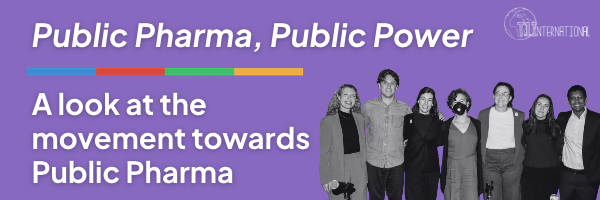
On September 28, 2026, we co-hosted “Public Pharma, Public Power: Taking Back Control of the Medicine Supply” at The New School in New York City with The Institute on Race, Power and Political Economy’s Health and Political Economy Project (HPEP) and NYU Law’s Science, Health, and Information Clinic (SHIC), NYU Law’s Engelberg Center of Innovation Law and Policy, and Economic Security Project.
The evening highlighted progress by the Partnership for Public Pharma (P3), a coalition of expert advocates, policymakers, and health leaders established last year. P3 works towards increasing public control throughout the pharmaceutical value chain as an alternative to a profit-driven system that keeps drug prices and limits access to medicine around the world.
Keynote speakers New York State Senator and Sponsor for the New York Affordable Drug Manufacturing Act (opens in a new tab) Gustavo Rivera and former NYC Health Commissioner and CUNY Professor Dr. Dave Chokshi kicked off the panel with their hopes for a world in which public pharma is a reality and a call for action. To make needed change, “[e]ither you turn on the light or turn up the heat” explained Senator Rivera, calling for more research on how public pharma can successfully lower drug prices (the “light” of knowledge) and the organizing power and powerful personal stories that the New York #insulin4all Chapter brings (the “heat” of advocacy).
Panelists included T1International’s Executive Director Shaina Kasper, T1International’s Community Development Director Allison Hardt, and New York #insulin4all Chapter Leader Max Goldberg as well as P3 experts: Researcher & Advocate Dana Brown, Health and Political Economy Project Director Mara Heneghan, and Connecticut Office of the State Comptroller Stephanie Krieg.
Mara explained that without public capacity in the pharmaceutical sector, private companies will keep overpricing profitable products such as GLP-1 receptor agonists and under-producing unprofitable ones such as tuberculosis drugs. She called this an unacceptable structure for producing essential goods.
In January, T1International named 2026 as our Year of Public Pharma. Shaina shared that the insulin price crisis continues despite the attention given to $35 insulin policies and that over 30% of respondents to our most recent survey reported rationing insulin because of cost. “Going just a couple of hours without insulin can lead to severe health consequences, diabetic ketoacidosis, and even death” she reminded us, making insulin a concrete example of why essential medicines need public sector support that is not tied to profit motives.
WHAT IS HAPPENING IN THE US?
In 2018, T1International started working with California and Washington on public production and creating the conditions to make public pharma and these long term solutions possible. Since then, nine states have joined ArrayRx, a multi-state collaboration of partners seeking to create pharmacy solutions that are accessible to the people in our communities to fight costs and take the meaningful first step towards public pharma.
Allison presented CalRx as a successful case study for how states can create a vehicle for nimbly addressing multiple affordability and accessibility challenges for a wide range of drugs, and be responsive to the current context. California established CalRx through legislation in 2020 with insulin as a priority drug to target; January 1, 2026 Californians can purchase a box of five insulin glargine pens for a fixed transparent price of $55. Allison noted that people rarely know what a prescription will cost before they reach the pharmacy counter, so a transparent, stable price matters. “Our advocates were really involved from day one,” shared Allison. After the law passed, they won a patient advisory council for the CalRx insulin program, so people with lived experience could inform its implementation process.
The work is far from over but the program shows a promising framework that other states can adapt and improve upon. Importantly, CalRx reaches beyond insulin. It supplies free naloxone to qualified entities in the state and also at $19 over the counter anywhere, and provides albuterol inhalers for free for every California public and charter school.
WHAT IS HAPPENING IN NEW YORK STATE?
T1International’s New York #insulin4all Chapter has spent the last year leading the campaign for the New York Affordable Drug Manufacturing Act. This bill would “give New York this very powerful tool to address the extractive killer pharmaceutical system that insulin dependent diabetics and so many other people know so well” as Max said on the panel. The bill would allow the state’s Commissioner of Health to establish partnerships with drug manufacturers to produce and distribute low-cost generic prescription drugs and biosimilars. This would lower prices and increase competition and supply.
After federal legislation suggested the insulin price crisis was over, the New York #insulin4all Chapter saw that patients still lacked access. Max shared that the Chapter considered emergency insulin laws and other policies but found that a public pharma option “ that you could rely on and trust” energized members most.
WHAT IS HAPPENING AROUND THE WORLD?
While this event was US-focused, it coincided with an important milestone in T1International’s Year of Public Pharma: the release of our Public Pharma Policy Report. (opens in a new tab)This report was compiled by five advocates in our Public Pharma Working Group who researched public pharmaceutical production and procurement in five different countries: Cuba, France, Lebanon, Pakistan, and Thailand. The report provides insight into what is already working, what’s missing, and where the next opportunities for public insulin production lie on a global scale. We’ll use this report to continue building our community-led campaigns for public pharma around the world.