
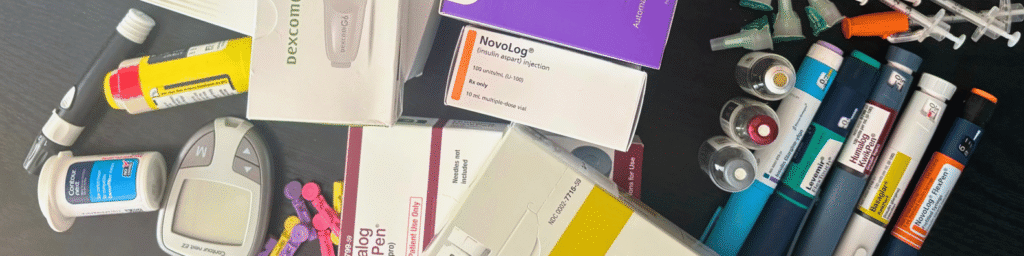
Get help affording essential medicines and supplies
Confused or overwhelmed?
These systems are set up to confuse us so that we just pay our full price! You may find it easier to call your prescriber or healthcare provider, navigate Beyond Type 1’s GetInsulin.org (opens in a new tab), calling a professional group like Blue Circle Health (opens in a new tab), or calling a volunteer-run group like Mutual Aid Diabetes (opens in a new tab).
Want to donate insulin or supplies to those in need?
- Mutual aid groups like Mutual Aid Diabetes (opens in a new tab) and Diabetes Aid Now (opens in a new tab) help connect people in need with those who have extra to share.
- Insulin for Life USA (opens in a new tab) distributes insulin to those in need in the U.S. and around the world.
More resources:
- To read more about insulin manufacturers’ insulin affordability resources, click here.
- To access supplies other than insulin, click here.
- To access a prescription, click here.
- For emergency insulin access and affordability resources, click here.
Barriers to access to insulin and other diabetes supplies can include unaffordable health care, institutional unresponsiveness, and major life transitions. Being unable to afford or access insulin or other required supplies is not the fault of any of us as individuals; rather, it is the outcome of decades of intentional policies and practices by Big Pharma.
You are not alone: about 10% of people in the United States do not have health insurance, 1 in 4 people with type 1 diabetes (opens in a new tab) have experienced interruptions in their health insurance, and about 60% of people without insurance in the US are people of color (opens in a new tab).
The ‘Big Three’ insulin producers, Eli Lilly, Novo Nordisk, and Sanofi, dominate more than 90% of the insulin market, meaning they can charge high prices. One in three people living in the United States with type 1 diabetes reported the dangerous practice of rationing their insulin due to price as the average patient cost of insulin has skyrocketed, resulting in devastating health complications and emergencies.
If you are in immediate emergency need, please seek help at a Hospital Emergency Department or by calling 911.
Note: This resource section covers ongoing insulin access in the United States.
See the Emergency Insulin Access Resources section for emergency insulin access in the United States.

Emergency Insulin Access Resources
If you are in immediate emergency need, please seek help at a Hospital Emergency Department or by calling 911.
Note: These resource covers insulin access in the United States only. These resources may be out of date and were last updated January 2026. for ongoing insulin access and affordability resources in the United States, see Low-cost insulins.
One in three people who are insulin dependent have reported the dangerous practice of rationing their insulin due to price. Being unable to afford or access insulin or other required supplies is not your fault; rather it is the outcome of decades of intentional policies and practices by Big Pharma.
Low-cost insulins
Low cost insulin analogues vials and pens are now available with a prescription at a more affordable list price than many other name-brand insulins, regardless of insurance or residency status (a prescription is needed in most states):
- Long-acting insulin glargine pens are available by CivicaRx (opens in a new tab) and Biocon for $55 for a box of 5 pens; this is available by label CalRx (opens in a new tab) in California. If you have a prescription for any long-acting insulin glargine (brand names Rezvolgar, Basaglar, Lantus, or Semglee) you should be able to use your prescription for this insulin. Note: CivicaRx or CalRx insulin glargine pens may not be available at your pharmacy.
- Rapid-acting generic insulin lispro vials by Eli Lilly (opens in a new tab) are available for $25 a vial; If you have a prescription for rapid-acting insulin lispro (name brand Humalog or Admelog) you should be able to use your prescription for this insulin. Novolog ReliOn is available at Walmart for $25 a vial and $43 for a box of 5 pens; if you have a prescription for rapid-acting insulin aspart (name brand Novolog or Fiasp) you should be able to use your prescription for this insulin. Note: Eli Lilly insulin lispro vials may not be available at your pharmacy and Walmart pharmacies may not have the Relion insulin in stock.
Please note that because of patent evergreening, insulins with small changes to their formula including Lyumjev, Tresiba, Toujeo, Apidra, and possibly Fiasp, Admelog and other insulins may not have their prescription be used for a generic or biosimilar because they do not exist. Levemir (generic, detemir) has been discontinued and is not available.
These insulins may not be available at your local pharmacy and you may have to special order them
Alec’s Laws (opens in a new tab) or Insulin Safety Net Laws provide low-cost insulin for the uninsured in Colorado (opens in a new tab), Maine (opens in a new tab), Minnesota (opens in a new tab), and Utah (opens in a new tab).
Blue Circle Health (opens in a new tab) can help adults with type 1 in 20 states and Washington D.C. access care and access support for up to 6 months.
Mutual Aid Diabetes (opens in a new tab) can help you navigate the below resources, get you one-time access to insulin and supplies, as well as help you find and navigate sustainable long-term solutions.
Insulin Manufacturers’ Insulin Affordability Resources
Many of the below insulin manufacturers’ Insulin Affordability Resources are challenging to access and may be terminated or modified at any time, which is one reason T1International supports structural reforms.
Manufacturer-sponsored cost-sharing programs
Manufacturer-sponsored cost-sharing programs, without strong price cutting measures and equitable insulin access, are not an answer to the insulin crisis. They are always time-limited and there is no guarantee that these programs will continue long-term—companies can end them at any time, putting patients at risk again. Sometimes extensive paperwork also requires the time and attention of health professionals. Reliance on coupons, savings cards, and patient assistance programs can circumvent efforts to use more cost-effective generic or biosimilar drugs. There are three main types of manufacturer-sponsored cost-sharing programs for insulin:
- Copay cards can be used by some patients with private insurance and they can reduce the patient’s out of pocket payment.
- Insulin savings cards or coupons can be used by some patients with private insurance, whose plan does not cover a certain insulin, and those without insurance and can reduce the amount that patients pay out of pocket. (see note on coupons and savings cards below)
- Patient assistance programs may provide insulin without out of pocket costs to some patients without insurance.
- Diabetes Solution Center (opens in a new tab) can offer $35 insulin through the Lilly Insulin Value Program by calling 1-833-808-1234 Monday – Friday 9am – 7pm ET
- Patient Assistance Program Lilly Cares Program (opens in a new tab) is available to people without insurance for $35 for qualified patients (under 400% of the Federal Poverty Level who have been denied from Medicaid.) 1-833-808-1234
- Copay Assistance Program Lilly Insulin Value Program (opens in a new tab) is available for people with commercial insurance and those without insurance for $35. 833-808-1234
- Generics/Biosimilars: Captive generic Lispro is available at 50-70% lower than branded Humalog; Rezvoglar is a biosimilar to Lantus by Sanofi; Basalgar is a biosimilar of Lantus.
- Human Insulin formulas (for example, Lilly’s Humalin) are also available for $25 per vial.
- Please note: human insulin works very differently than analogue insulins. If you are forced to switch insulins, be sure to reference an accredited insulin switching guide (opens in a new tab) and talk to your prescriber.
Note: Lilly Insulin Value Program requires downloading a card and printing or presenting it on a mobile phone at the pharmacy.
- NovoCare Immediate Supply (opens in a new tab) can offer up to 3 vials or 2 packs of pens, or a combination. You will need to print or email a card once you fill out the online form to bring to the pharmacy. You can also call 1-844-668-6463 Monday – Friday 8am – 11pm and Saturdays 11am – 7pm ET
- Patient Assistance Program: NovoCare Patient Assistance Program (opens in a new tab) is available for qualified people without insurance or on Medicare for free. Novo Nordisk also offers a temporary Immediate Supply Program (opens in a new tab) while Patient Assistance Programs are being processed 1-844-668-6463
- Co-pay Assistance: My Insulin Rx (opens in a new tab) is available to qualified people with private insurance or without insurance for $35 a month up to 3 vials or 2 packs of 5 pens. Text ENROLL to 24177 or call 1-844-668-6463; Coupons (opens in a new tab) are available for those with private or commercial insurance for qualified people.
- Generics/Biosimilars: Captive generic Aspart is available for less than the branded Novolog.
- Novo Nordisk’s Walmart private brand, ReliOn offers aspart insulin for 58-75% off the branded Novolog.
- Human Insulin formulas (for example, Novo’s Novolin) are available at many Walmart (ReliOn brand) and other stores for $25 per vial.
- Please note: human insulin works very differently than analogue insulins. If you are forced to switch insulins, be sure to reference an accredited insulin switching guide (opens in a new tab) and talk to your prescriber.
- Patient Assistance Program: Sanofi Patient Connection (opens in a new tab) 1-888-847-4877 is available for people who qualify without insurance who been denied Medicaid or with no insurance coverage of the product who are less than 400% of the Federal Poverty Level for $0.
- Co-pay Assistance: Insulin Valyou Savings Program (opens in a new tab) are available for qualified people with private insurance for up to $35 for a 30-day supply. 1-833-813-0190
- Generics/Biosimilars: Captive generic Glargine is available for 60% less than the branded Lantus; Admelog is a biosimilar of Lilly’s Humalog.
- Patient Assistance Program: Biocon’s Patient Assistance Program (opens in a new tab) may be available for patients without insurance for $0. The form must be emailed or faxed. 1-844-224-6266
- Copay Assistance Program: The SEMGLEE savings Card (opens in a new tab) is eligible for patients with private insurance for up to $94 for a 30-day supply.
- Generics/Biosimilars: Semglee is a biosimilar interchangeable of Sanofi’s Lantus. It is available as CivicaRx or CalRx brand as well, at a price of $55 for a box of 5 pens.
A note about Insulin Manufacturers’ Insulin Affordability Resources
We know that producing most analogue insulins costs less than $10 a month (opens in a new tab) and yet they can cost over $300 a vial. High prices have been driven by greed, not other factors. This is not your fault! You are not alone in navigating this needlessly complicated and inaccessible system.
Support programs differ (opens in a new tab) on the level of cost-sharing assistance, quantity of insulin provided, and program duration. They are often found to be unusable for patients who need them. Many patients are ineligible to apply: most programs limit their eligibility to US residents, require that patients accessing savings cards and patient assistance programs have an annual household income of less than 400% of the federal poverty level and do not qualify for Medicaid or demonstrate that they were denied Medicaid if eligible, and that patients do not qualify for low-income subsidies if covered under Medicare Part D. Most copay card, savings programs, and patient assistance programs have maximum supply per fill, quantity limits, expiration dates, as well as costs to patients. Programs can also have thresholds of maximum savings and it is unclear if patients can re-enroll after program expiration. Because these programs are provided by private corporations, they can be canceled or changed at any time, or patients can be found ineligible for coverage.
Patient assistance programs do not have to be HIPAA compliant. LillyCares (opens in a new tab), NovoCare (opens in a new tab) and Sanofi Patient Connection (opens in a new tab) applications all have the applicant sign away their right to privacy. The applications state that the data they collect are not covered by federal and state privacy laws like HIPAA and may be used by the company in marketing and sales, or the data can be shared or sold with other drugs or other companies. While these data privacy concerns do not directly impact prices, they are important considerations to many patients who may choose to not use these programs, despite cost concerns. Note that Coupon consolidator GoodRx (opens in a new tab), for example, has sold medication and intimate details of users with 20 internet companies, and in their overstepping, was recently hit with a $1.5mil fine (opens in a new tab) for allowing the data to be used for digital marketing purposes.
Coupons and savings cards can be used by manufacturers to ‘product hop’ patients to new drugs. Coupon and savings card programs can overcome cost barriers to increase newer insulin access and use for patients in the short-term, building brand-name loyalty. They can be used by those with commercial insurance plans (and those without insurance) to move patients to newer, more expensive drugs by covering the initial costs, a practice called ‘product hopping’. Coupons have been found to increase the purchase of name-brand drugs over generics by over 60% (opens in a new tab). These programs have been estimated to increase the cost of prescription drugs up to $32 billion (opens in a new tab).
Copay assistance programs, through copay cards or coupons, reduce the amount that patients pay out of pocket through their insurance plans each month. Big Pharma gets tax breaks, increased sales, raised revenue and positive public relations when they give coupons for lowered product costs to those who can’t afford it through these programs, making it a win-win for them – one study showed that for every $1 invested in these programs, the donor company can garner up to $21 back.
Big Pharma makes donations to third party patient assistance programs which are often viewed as “investments” for future returns. One example is Sanofi’s program, as exposed in the Dec 2021 Drug Pricing Investigation staff report (opens in a new tab). Exposed emails from Sanofi show that while Sanofi expected the patient assistance program to reduce net sales for Lantus, the impact would lead to an expected increase in sales volume, and led to a three-fold increase in Lantus use. Sanofi also launched a patient affordability program to mitigate the negative media around price increases.
These third parties may terminate or modify their patient assistance programs at any time, including changing eligibility criteria and level of assistance. That’s why T1International supports structural reforms to lower insulin prices and to enhance transparency and accountability of manufacturer-funded patient assistance programs, including through public pharmaceutical manufacturing and distribution. The programs tied to insulin manufacturers listed below may be arduous or difficult to qualify for, but can be worth checking out if in need.
Finally, all but one follow-on and generic are all manufactured by the Big Three and, for that reason, do not offer significant cost savings to patients or payers. The two follow-on insulin formulations are Basaglar, a Lilly follow-on of Sanofi’s Lantus introduced in 2015, and Admelog, a Sanofi follow-on of Lilly’s Humalog introduced in 2018. “Authorized generic” insulins are not true generics in the pro-competitive sense that patients normally think of; they are instead exact copies of the brand-name products made and sold by the same companies that make the brand-name products. These include Lilly’s Lispro (a copy of Humalog) and Novo Nordisk’s aspart (a copy of NovoLog). Authorized generics are not widely available in pharmacies (only ~17% (opens in a new tab)); the Big Three keep supplies low to keep patients on their higher-priced brand-name products.
Drug Discount Programs & Cards
ArrayRx (opens in a new tab) is a state-managed drug discount card program available for patients in Arizona, Connecticut, Nevada, Oregon, and Washington, as well as certain people in other states. ArrayRx operates independently from manufacturers and does not ever sell data.
Often private drug discount programs and cards cannot be used with your health insurance, meaning you either pay the insurance price or the cash price set by the program. In the long run, they may end up costing patients more money. Read about one patient’s experience here. See “A note about Insulin Manufacturers’ Insulin Affordability Resources”. Many of these other resources receive funding from insulin manufacturers, sell data, etc.
- Benefits Checkup (opens in a new tab)
- Blink Health (opens in a new tab)
- Family Wize (opens in a new tab)
- GoodRx (opens in a new tab)
- Inside Rx (opens in a new tab)
- Medicine Assistance Tool (MAT) (opens in a new tab)
- Needy Meds (opens in a new tab)
- Partnership for Prescription Assistance (opens in a new tab)
- Patient Advocate Foundation (opens in a new tab)
- Reduced Rx (opens in a new tab)
- RxAssist (opens in a new tab)
- RxHope (opens in a new tab)
- Rx Saver (opens in a new tab)
- Single Care (opens in a new tab)
- WellCard Savings (opens in a new tab)
Prescriptions
Depending on where you live, you may need to have an up-to-date prescription to get insulin. If you cannot get a hold of your prescriber for an up-to-date prescription, here are some other resources to try:
Prescription Access
- Kevin’s Laws can allow emergency refills in many states, often from the pharmacy that recently filled a recently-expired prescription. Many pharmacists are under-educated about these rules and laws, so be sure to ask for them specifically. Many states do not have an insurance mandate and so you may have to pay out of pocket.
- Blue Circle Health (opens in a new tab) can provide free clinical care to adults living with type 1 diabetes living in Alabama, Connecticut, Delaware, Florida, Indiana, Iowa, Kentucky, Louisiana, Maine, Maryland, Massachusetts, Mississippi, Missouri, New Hampshire, Ohio, Pennsylvania, Rhode Island, Tennessee, Vermont, Virginia, and Washington D.C. for up to six months regardless of citizenship.
- Free & Charitable Clinics (opens in a new tab) and Community Health Centers (opens in a new tab) assist the medically underserved in communities across the U.S. by ensuring that they have access to affordable health care. You may have to get insulin at the clinic-run pharmacy following your clinical care appointment.
- Human insulins are available without a prescription. Please note that this is human insulin which works very differently than analogue insulins. If you are forced to switch insulins, be sure to reference an accredited insulin switching guide (opens in a new tab) and talk to your pharmacists or prescriber with any questions. Human insulin label ReliOn (opens in a new tab) is available at Walmarts for Novolin N insulin for $25 a vial and $43 for a box of 5 pens, and Relion 70/30 mix for $58 a vial and $84 for a box of 5 pens.
Get Health Insurance
Note: If you are an undocumented aspiring American or a DACA recipient, you are not eligible for health insurance through the above pathways. Some people who were eligible for different above insurances before the passage of HR 1 lost that eligibility and will be disenrolled by Jan 2027.
Blue Circle Health (opens in a new tab) provides free clinical care and insurance navigation to adults living with type 1 diabetes living in Alabama, Connecticut, Delaware, Florida, Indiana, Iowa, Kentucky, Louisiana, Maine, Maryland, Massachusetts, Mississippi, Missouri, New Hampshire, Ohio, Pennsylvania, Rhode Island, Tennessee, Vermont, Virginia, and Washington D.C. for up to six months.
Medicaid and CHIP (opens in a new tab) are state-administered health insurance programs for low-income individuals and families. Each state has their own eligibility requirements, often including pregnant people, children, parents, people with disabilities, and Medicare beneficiaries. Medicaid expansion states can extend eligibility to low-income adults. Medicaid covers health care and prescriptions; costs vary by state. The Children’s Health Insurance Program (CHIP) is a state-administered health insurance program for children from families too high to qualify for Medicaid and some pregnant people and parents. The Health Insurance Marketplace in each state offers a single application (opens in a new tab) to determine eligibility for Medicaid, CHIP, and the private marketplace.
Medicare (opens in a new tab) is a federal government health insurance program for citizens over 65 years old or with certain health conditions. You will have to pay to be on Medicare insurance. As of 2023, Medicare insurance plans cannot charge patients more than $35 for a one-month supply of each insulin you take.
Affordable Care Act or Marketplace (opens in a new tab) health insurance plans are state-administered private health insurance programs available for citizens in each state. You will have to pay to be on a Marketplace insurance plan and sign up during Open Enrollment between Nov 1 and Jan 15 or if you have a qualifying life event. You can qualify for savings like a premium tax credit to lower your monthly plan or find out if you qualify for Medicaid or CHIP (noted above) by applying for Marketplace coverage. As of 2014 all health insurance plans cannot deny coverage or charge more because of diabetes or other preexisting conditions like diabetes, and many states have copay caps for monthly insulin prescriptions for state-based plans.
Supplies
Insulin is only as good as it can get into your body at the right amount. Glucose self-monitoring supplies and injection supplies are also necessary supplies for diabetes care. Below are links to different assistance programs for glucose self-monitoring supplies and injection materials:
- Abbott’s Libre (opens in a new tab) offers a copay card (opens in a new tab) for eligible patients on privately insured or cash-paying customers starting at $75 for two sensors at participating pharmacies. 1-855-632-8658
- Contour Choice Test Strip Savings Card (opens in a new tab) and coupon (opens in a new tab) is for eligible private insured or cash-paying customers up to $105
- Contour test strips are also available for $27.50 for a box of 70 test strips without a prescription
- BD Insulin Syringe Assistance Program offers a patient assistance program for people who use BD Ultra-fine insulin syringes for people who are privately insured or cash-paying by phone only 1-866-818-6906
- BD pen needles are available starting at $20 for a box of 90 for cash-paying customers without a prescription
- Dexcom’s Patient Assistance Program (opens in a new tab) offers discounts to eligible US residents who meet certain criteria.
- Coupon (opens in a new tab) can save $230 on a 30-day supply of sensors and $200 for Dexcom receivers at participating pharmacies
- Dexcom also offers Stelo Glucose Biosensor (opens in a new tab) for $99 for people who are not on insulin or dialysis without a prescription.
- Coupon Card (opens in a new tab) offers $10 meter vouchers and savings programs at participating pharmacies for eligible private insured or cash-paying customers starting at $35 for 100 test strips
- Coupon Card (opens in a new tab) offers meter test strips and lancets for cash-paying customers at eligible pharmacies for $49.99
- OTC: Accucheck offers $29.99 for 100 testing (opens in a new tab) strips for cash-paying customers without a prescription.