
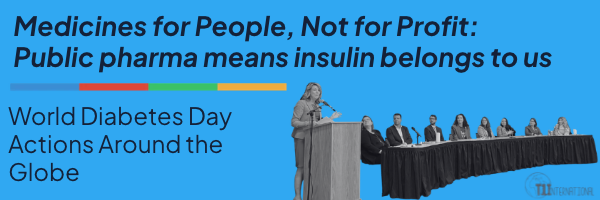
Every 14 November, World Diabetes Day gives the world a moment to talk about diabetes. For T1International, it is also a moment to ask who controls the medicine that keeps us alive, and who sets its price. This year we’ve focused on Public Pharma for its clear alignment with our mission. We’ve focused on public pharma primarily in the US with Allison, our Community Development Director, leading the charge. The past year we’ve sought to expand that work to a global scale.
The idea is simple. Essential medicines should serve the public good, not private profit. From New York to Gaza, advocates showed what that looks like in practice this World Diabetes Day.
New York: Learning Our Way to Legislation
On World Diabetes Day, the New York #insulin4all Chapter hosted a Public Pharma Teach-In to prepare for the next legislative session, as the chapter pushes to pass the New York Affordable Drug Manufacturing Act.
Advocates and experts from across the space came together to explain what we mean by public pharma, share what is already in motion in New York, and write postcards to targeted elected officials. The Chapter’s top priority is the New York Affordable Drug Manufacturing Act, which would allow the state to contract for or produce its own essential medicines, saving both the state and patients money while helping address drug shortages.
Not only did New York #insulin4all Chapter members speak, but they were joined by partners from New York University’s Science, Health, and Information Clinic, from I-MAK, and from the New York City Department of Health and Mental Hygiene.
The teach-in builds on last September’s “Fixing a Broken System” event at NYU Law, which brought together patients, legal advocates and policymakers. The work moves from education to action, and the legislature is the next stage.
Ohio: Exploring Public Options for Pharmaceutical Security
In Ohio, advocates came together at Ohio State University to discuss ways to improve access to insulin and other life-saving medications through public pharma. The event was sponsored by the Infectious Diseases Institute and included panelists from T1International, Ohio State University, Gavin Gill Foundation, along with Munira Abdullahi and Allison Russo of the Ohio House of Representatives.
Panelists shared their first hand experiences as patients, advocates, medical providers, educators and industry professionals navigating the for-profit pharmaceutical industry, and offered perspective on the future of public pharma and explored the need for publicly owned options to achieve affordable access to medicines.
Gaza: Diabetes Under Siege
Some of our most urgent work this year has been about people living with diabetes in conflict zones. The “Diabetes Under Siege” social media campaign by our Gaza #insulin4all Chapter put a spotlight on the humanitarian crisis in Gaza, where insulin, test strips and basic diabetes care have been scarce for years by publishing testimonies from people with type 1 diabetes in Gaza describing rationing expired insulin and going without test strips on our social media (opens in a new tab). One chapter member described the double bind of managing insulin without supplies: eat without it and your sugar climbs dangerously, eat less and you risk a life-threatening low.
The Gaza #insulin4all Chapter, in sharing their stories,shows why medicine access cannot depend on supply chains that a blockade can cut.
One Movement, Many Places
Earlier this year, we created a Public Pharma Working Group. Five members from Uganda, Pakistan, France, Lebanon, and the United States researched public pharma initiatives and wrote policy briefs (opens in a new tab) on five countries: Cuba, France, Lebanon, Pakistan, and Thailand. Each brief assesses how feasible public pharma is in that setting and identifies questions that need answers, organizations that could work together, and opportunities for further investigation. In some countries, established public manufacturers and experience with biologics provide a foundation. Elsewhere, the immediate opportunities lie in procurement, regulation, advocacy, and building institutions that serve public needs.
Leading up to World Diabetes Day, members of the Public Pharma Working Group trained other #insulin4all advocates as part of a mobilization. The mobilization brought advocates together to train in sharing their powerful, personal, and political stories and to apply these lessons in working on public pharma. In the week leading up to World Diabetes Day, participants shared their stories in a series of social media videos (opens in a new tab). On World Diabetes Day, we featured some of these videos at our first-ever webinar, which welcomed people from 14 countries to learn about our work countering high prices and limited access to essential medicines. If you missed the live session, you can watch the recording here (opens in a new tab).
While these many different actions look different on the surface, they share one belief: Public pharma matters because essential medicines should serve the public good, gives communities a more secure supply. When life-sustaining medicine depends on a handful of corporations, price spikes and delays become a matter of life and death. Public Pharma offers another path, in which production is guided by human need.
Take Action
World Diabetes Day may be over, but the work isn’t.
Insulin belongs to us. Let’s make sure it reaches everyone who needs it.
Share your story with #insulin4all #PublicPharma and tag @t1international
